
What Beaver Property Tax Records Contain
Beaver property tax records live in two offices. The Assessor establishes market value and applies residential or greenbelt treatment to qualifying parcels. The treasurer or auditor does the rest. That office applies the rates set by taxing entities. It records payments and handles delinquency and relief. The county publishes no live tax search or parcel-card field list.
| Field | What It Shows | Where |
|---|---|---|
| Market value | Assessor estimate of fair market value for the assessment date | Beaver County Assessor |
| Taxable value | Value after any eligible exemption or classification | Assessor and state guidance |
| Greenbelt | Agricultural valuation classification and application record | Beaver County Assessor |
| Tax bill and status | Amount due, paid, delinquent, or eligible for relief | County treasurer or auditor |
| Tax district | Combination of taxing entities applied to the parcel | County tax record; SGID may carry a district field |
Market value is not the tax bill. The bill reflects taxable value and local levies. Utah generally taxes a qualifying primary residence on 55 percent of fair market value after a 45 percent exemption. Sale price, market value, taxable value, and amount due are four distinct figures, and mixing them up causes most confusion on a Beaver tax account.
Beaver Values Use a January Date
Every January 1, Utah assessors put a fresh fair market value on real property. In Beaver County, the Assessor's office covers a wide portfolio: residential, commercial, agricultural, and vacant land values. It also handles personal property and greenbelt. Declarations and real-property board appeals are included too. Two things sit outside its reach. It does not set mill levies, and it does not collect the tax. That division of labor matters when questions come up. An assessed-value dispute and a bill payment belong at different desks.
For valuation duties and greenbelt details, the county's Assessor page is the place to look.
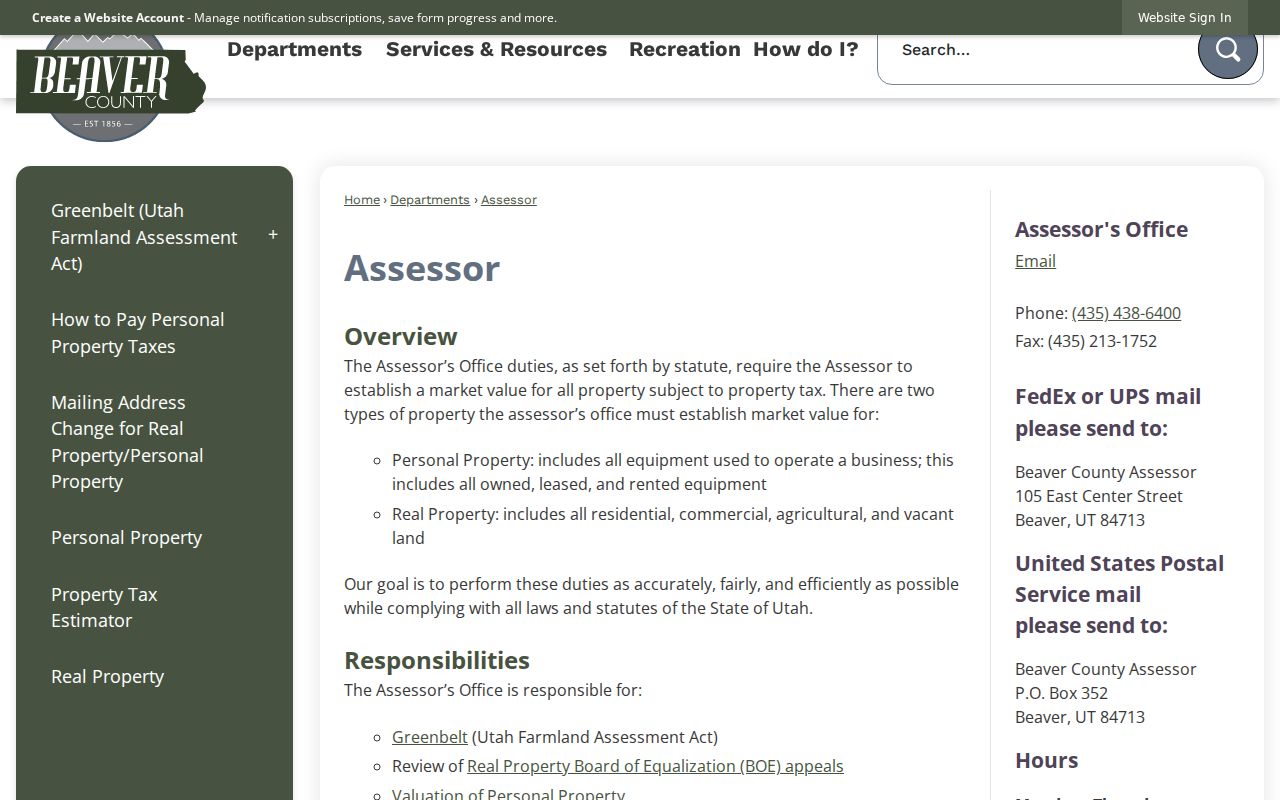
The Assessor page displays the office's role, not a parcel-specific tax result or search form. Note the value date on any notice. Note the parcel ID as well. A shift in market value does not by itself explain a bill change, because the taxable share, tax district, levy, and exemptions all move the final figure.
Utah's Residence Exemption Changes Taxable Value
Utah generally exempts 45 percent of fair market value on a qualifying primary residence, leaving 55 percent taxable. That is not a discount. Nothing is subtracted from the bill after the math. The exemption changes the value the local rate is applied to. The state's application path uses forms PT-19A and PT-19B. Notice timing depends on the situation. Qualifying use and record status should be confirmed with the Beaver County Assessor. Never assume an exemption transfers at a sale. Keep four figures side by side. Those are market value, taxable value, exemption type, and tax year for the Beaver parcel. A missing residence indicator is an Assessor question, while an unpaid balance belongs with the treasurer or auditor.
Greenbelt Is a Separate Beaver Record
Greenbelt is its own Beaver record. The county Assessor administers agricultural greenbelt valuation alongside residential declarations. A farm parcel is not a residential lot. Greenbelt classification rests on its own facts and its own application process. Do not infer it from acreage alone. A SGID land label does not settle it either. County Assessor material includes greenbelt information and application links, and the office can say which tax year and classification apply to a particular parcel. A later sale or land-use change can make earlier assessment records useful context. An old classification does not establish current eligibility. Beaver's rural landscape makes this distinction practical: a large parcel, a water-right reference, or a mining history is not proof of agricultural valuation. Read the record itself, then verify with the county.
Find a Beaver Tax Bill by Parcel
The county offers no public online bill search. Start with a parcel ID. Ask the Beaver County treasurer or auditor where the current bill, payment history, delinquency status, and relief information are available. An Assessor value notice helps identify the parcel, but it is not a payment receipt.
- Copy the parcel ID and tax year from the county notice or SGID layer.
- Ask the treasurer or auditor for the bill and payment-status record for that year.
- Check with the Assessor if the market value, primary-residence status, or greenbelt field looks wrong.
- Ask whether an unpaid tax has moved to a lien, sale, or redemption record.
- Market value
- The Assessor's estimate of fair market value on the annual valuation date.
- Taxable value
- The portion used to calculate the bill after an exemption or classification.
- Levy
- The rates set by local taxing entities and applied to taxable value.
- Tax lien
- A claim associated with unpaid property tax; verify its current status with the county.
Beaver Delinquency Follows a State Calendar
Utah's statewide property-tax publication sets the calendar. Unpaid taxes become delinquent after November 30. The penalty is 2.5 percent or $10, whichever is greater, with a reduced penalty for payment by January 31. Interest may accrue from the January after delinquency. Ask Beaver County for the current amount, because the statewide summary is not a parcel balance. The treasurer or auditor is the route for payment, delinquency, tax relief, and rate questions. The county publishes no current delinquent-list or auction portal. A stale notice, map layer, or prior-year bill is not the payoff figure.
Archives Preserve Older Beaver Tax Sales
The Utah State Archives holds a long paper trail of Beaver tax sales. Finding aids list county tax-sale records from 1896 through 2021. Tax deeds run from 1896 through 1942. Those series trace a former tax sale or deed. They are not a current delinquency list, bill, or redemption status, so ask Archives staff how to locate the series and ask the county for today's tax position. The Archives announcement shows the Beaver collection names.
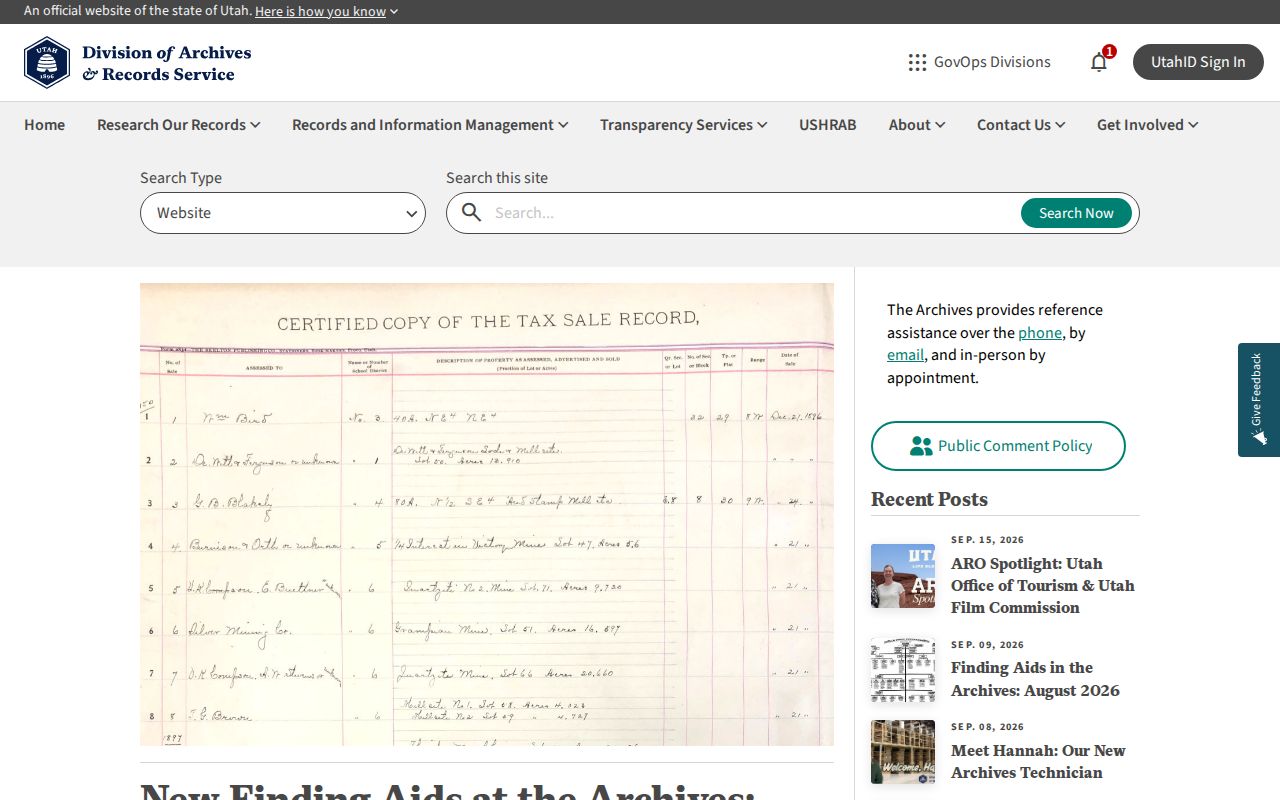
A tax-sale record is only the start. Match it to the legal description and the later deed before drawing any ownership conclusion. When a tax record points to a court dispute, the Fifth District case file is a separate source. Public case information runs through Xchange, and the Beaver clerk provides copies.
Appeal a Beaver Market Value on Time
Beaver County owners have two deadlines to watch. Utah's locally assessed appeal guidance sets July 22 as the valuation-notice deadline. September 15 is the filing deadline for the county board of equalization. The Beaver Board of Equalization contact listed in the state publication is 435-438-6465. Confirm the notice and official instructions for the year at issue. The deadline is tied to that process. An appeal challenges the Assessor's market-value conclusion. Helpful evidence includes recent comparable sales, condition details, photographs, and a repair estimate. It may also include any other fact bearing on value as of the assessment date. A dispute over the tax rate or levy belongs with the taxing entity instead.
Keep a bill's parts in separate columns when reviewing it. List assessed value, taxable value, rate, exemption, and amount paid. The total can change for several reasons. A new valuation can move the number. A classification or exemption adjustment, a rate change, or a carried-forward balance can each move it too. Beaver County publishes no public tax-bill portal. Contact the county tax custodian with the parcel number and tax year. Ask for bill detail that explains the specific amount rather than an older receipt. Greenbelt questions differ from ordinary residential exemptions. Agricultural classification depends on the parcel's qualifying use and declaration, and the Assessor's office handles that valuation-side issue. Changes in land use or acreage can affect classification. Ask what documentation the office needs and which assessment year is under review. Do not assume an agricultural-looking parcel automatically qualifies.
Historic tax records can help follow an older transfer. They demand careful reading because a single entry rarely tells the whole story of a parcel's ownership. The Utah State Archives lists Beaver County tax deeds from 1896 through 1942. Tax-sale records run from 1896 through 2021. A tax-sale entry is a clue, not a title opinion. Match it to the legal description and later deed. Consult the relevant court record when a sale or redemption is disputed. That is where redemption questions get settled. For a current bill or account status, include the parcel number, tax year, and the question being asked. A bill may reflect an Assessor-set value and one or more taxing rates. It may also carry a residential or agricultural classification, adjustments, payments, and any unpaid balance. These pieces may live in separate systems. Beaver County offers no confirmed public bill-search portal. Ask the county which office handles a payment, delinquency, exemption, or correction request. Obtain the current written account detail.
Ask for the bill and transaction history when the question is whether a payment posted. Ask as well when an amount remains due. A receipt may show one person's payment without revealing the whole account for later years. A property transfer alone does not confirm that every prior balance, lien, or adjustment was resolved. Keep the bill year and parcel identifier on each document. That habit prevents mixing one account history with another property at a similar address. An older receipt never proves the parcel is clear. A later balance or recorded lien can still exist. Check the account for the correct year. Confirm any claimed release or tax sale in the appropriate official record before relying on it. A tax inquiry explains billing. A title professional evaluates whether a tax event affects title.
Appeal window. Use the date and filing method on the current Beaver valuation notice. Utah's locally assessed guidance gives September 15 as the annual board-appeal deadline; confirm this year's instructions with the county before filing.