
What Beaver Deed Records Can Show
The Beaver County Recorder keeps the recorded instruments. The office can also track down who holds a parcel. Not all deeds promise the same thing. A warranty deed, a quitclaim, and a special-purpose deed each convey a different scope of interest. They also carry different assurances from grantor to grantee. The deed type alone proves little about liens or easements. It says nothing about unpaid tax bills or rival claims that may cloud the land. When you write to the office, describe the property as precisely as you can. Name the exact instrument you need. Vague requests slow everything down.
| Deed Type | What It Does | Common Use |
|---|---|---|
| Warranty deed | Conveys the grantor's interest with stated title warranties | Common sale between unrelated parties |
| Quitclaim deed | Transfers whatever interest the grantor has, if any | Family, trust, or name changes |
| Grant deed | Conveys an interest subject to its terms | Review the full recorded instrument |
| Executor or trustee deed | Transfers an estate or trust interest | Probate or trust administration |
| Tax deed | Records a transfer tied to a tax sale | Historic tax-sale research |
A deed transfers an ownership interest from one party to another. Financing works differently. A mortgage or deed of trust secures a debt. Only a later reconveyance or release clears that claim from the record. Watch for one common trap. A payoff letter from a lender is not the same as a recorded release. It leaves the lien formally in place. For an old loan, request the original instrument and its satisfaction together.
Beaver's Deed Index Is an Office Request
Beaver County has not put its land-record system online, according to the Recorder. That means no public grantor-grantee search and no browsable deed images through the county site. The office does accept requests for recorded documents, parcel histories, legal descriptions, surveys, and plats. You can reach it through an online form, email, phone, mail, or an in-person visit. Give the staff every identifier you can gather. A parcel or tax ID helps narrow the search. So do an owner name, situs address, section-township-range, or lot and block. Say which record type you want, plus any known date or party. The Recorder will search for ownership of a parcel. The office cautions that it is not a title agency, though. It will not run extended title research for you. The official Recorder request page posts the current form.
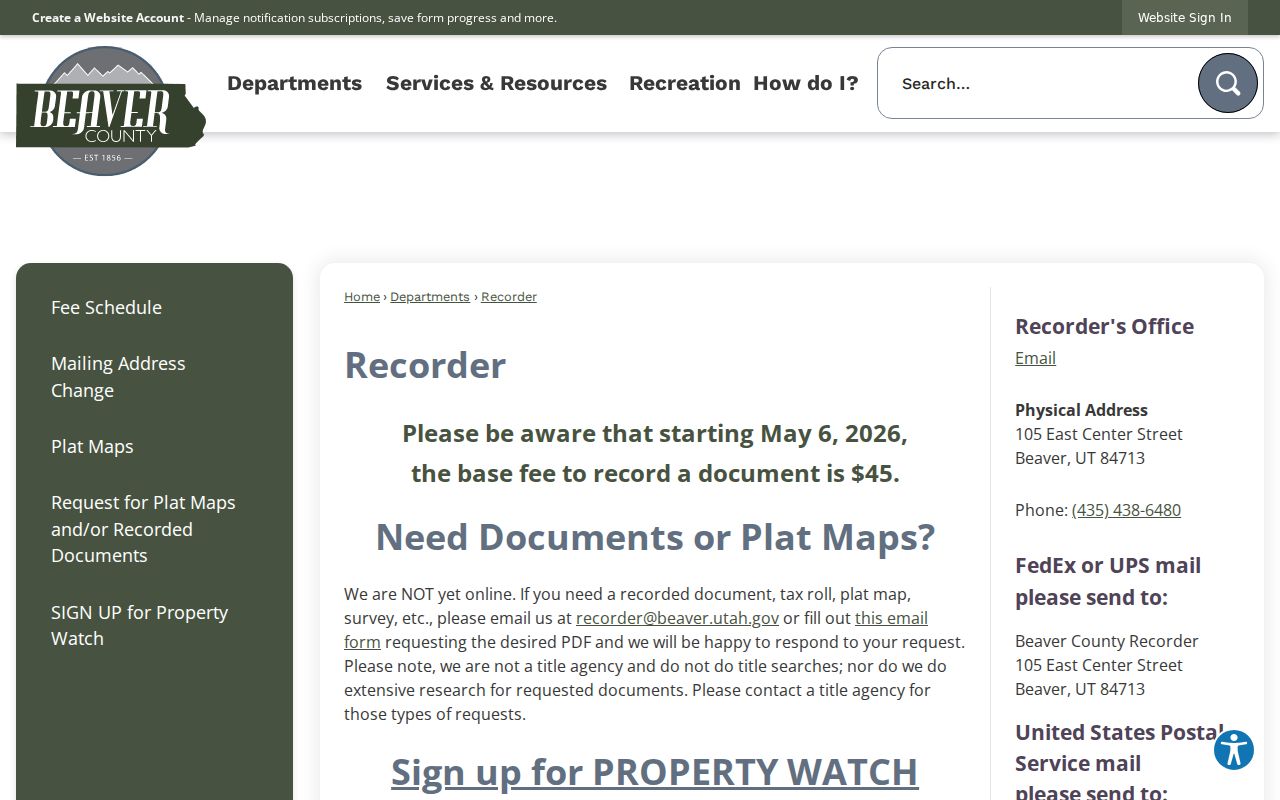
The captured page shows the request route, not a searchable deed-index screen.
Beaver Request Fields Are Clues
The Recorder's request page offers no structured search form. Instead, it lists the details staff say help them locate a record. Treat these as request clues, not live portal filters.
| Request detail | Role | What is known |
|---|---|---|
| Address, owner, or parcel | Identification | Give as much identifying detail as possible |
| Document type or date | Optional narrowing clue | Deed, mortgage, reconveyance, lien, plat, or survey may be requested |
| Section-township-range or lot and block | Legal-description clue | Recorder requests a plat map using these details when available |
The more specific your request, the better staff can sort parcels that share similar names or addresses. Ask the Recorder up front whether the years and document type you need are available before ordering copies.
Trace a Beaver Deed From Party to Party
Beaver County publishes no grantor-grantee index online. Work from the deed copy itself once you have it. The grantee names the person or entity receiving the interest. The grantor identifies the party giving it up. If the instrument leaves gaps, ask the Recorder for a prior deed reference or a full parcel history. A recorded chain can hold more than straightforward sales. Note probate transfers, trust transfers, tax deeds, and court-ordered conveyances separately as they appear.
- Find the latest deed or parcel history tied to the subject land.
- Record the grantee, grantor, recording date, and legal description shown on that document.
- Ask for the prior instrument that connects the last grantor to the property.
- Repeat with each prior owner and keep the parcel description beside the names.
- Grantor
- The party that conveys an interest in a deed.
- Grantee
- The person or entity that receives the interest.
- Chain of title
- The ordered series of recorded transfers for a parcel.
- Parcel ID
- Beaver's plat-map key uses book, page, and number parts; it is not a deed-book citation.
Beaver's Fire Loss Sets a History Limit
Surviving Beaver County land records date only to the late 1800s, the Recorder reports. A fire destroyed the earlier books. The exact fire date and the volumes lost remain unidentified. Skip any claim of a precise cutoff year. Never assume every parcel shares the same chain depth. County material from 2025 adds a wrinkle. Staff can provide a property history reaching back to 2000. Anything earlier calls for a formal title search. That limit can coexist with the older surviving books. An office history service, an online index, and the physical record span are three different things. Always ask which source a requested history actually covers. For work before the county's surviving range, the Utah State Archives Beaver finding aids and FamilySearch catalog listings may fill gaps. An archive series is a locator, not a complete land-title run.
Archives Add Tax and Court Transfers
The Archives lists Beaver County tax deeds covering 1896 through 1942. Tax-sale records run from 1896 to 2021. Fifth District civil files span that same long stretch, 1896 to 2021. Together these collections can explain how land moved after a tax sale, a quiet-title case, or a foreclosure action. Keep one thing in mind. A finding aid points you toward the record; it is not the deed itself. The Archives announcement names each Beaver series in turn.
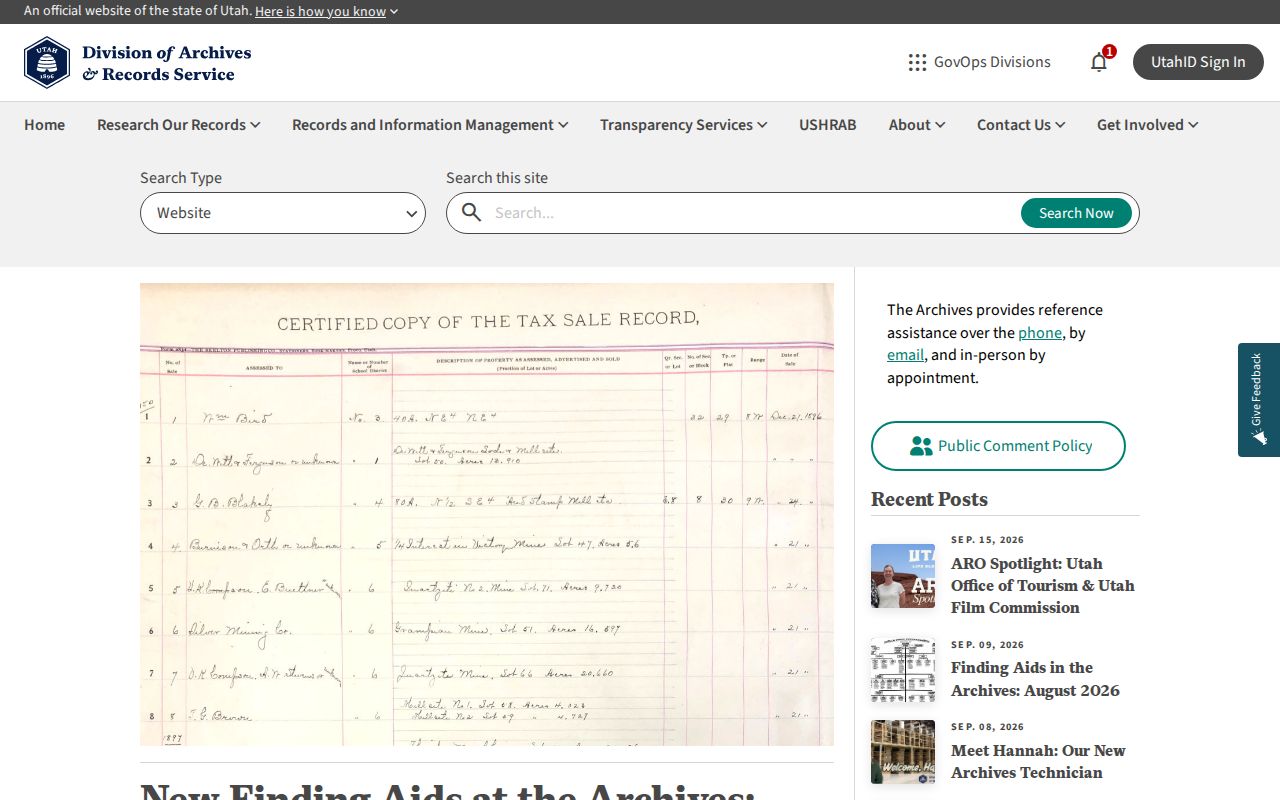
Ask Archives staff for a series description, along with instructions for requesting a copy or booking a reference appointment.
Check Releases Beside Beaver Mortgages
A Beaver deed search turns up more than deeds. Mortgages, deeds of trust, reconveyances, federal tax liens, mechanic's liens, easements, and mining claims all sit in the same land record. Payoff letters can lag. When a loan is paid, look for the recorded release or reconveyance rather than trusting the letter alone. If a lien appears without a release, ask the Recorder or a title professional to check the current land record.
The county fee schedule sets $45 for a federal tax lien or a release. A basic recorded document also costs $45. That base covers ten legal descriptions. Each additional legal description adds $2. UCC filings are different. Utah Commerce handles those central filings, and a UCC notice is not automatically a real-property lien.
Water rights run on a separate trail. The county Recorder says it can search property and water rights, while the Utah Division of Water Rights offers a specialist search by owner or water-right number.
Order a Beaver Deed or Certified Copy
Copies of Beaver deeds come from the Recorder, not a public image viewer. Use the request form or email first. Phone or counter staff can clarify a parcel clue. A plain letter-size copy is listed at $1 per page or PDF, while a certified copy costs $5 per page. Large plat copies carry size-based charges. Ask for the current total before sending payment. The fee schedule adds a subdivision recordation fee of $55 plus $2 per lot, and a $45 base for a recorded document with up to ten legal descriptions. The schedule says it took effect May 6, 2026. Fees can change. Confirm current fees with the county before mailing money.
Not every land instrument transfers full ownership. A deed of trust or mortgage secures an obligation. An easement grants only a limited right to use land, and a release or reconveyance can clear an earlier security interest. Each type leaves its own mark. A correction deed may clarify a legal description. Read the operative language, the parties, the referenced instrument, and the legal description rather than trusting the document's title. Titles mislead. When the question is whether an interest survives, compare the later releases and let a title professional review the chain.
Before ordering, decide what you need. Choices include an ordinary image, a certified copy, a plat, or help locating an older instrument. The Recorder accepts requests by email, form, phone, mail, and at the counter. Published hours run Monday through Thursday, 8 a.m. to 5 p.m., and Friday, 8 a.m. to noon. The office is at 105 E Center Street in Beaver. Mail goes to PO Box 431, Beaver, Utah 84713. Verify details on the county page before a trip. A property-history request is not a title examination. Recorder staff can locate ownership, recorded instruments, parcel history, and legal descriptions. The office cautions that it is not a title agency and does not perform extensive title research. Its stated service reaches property history back to 2000. That limit does not mean older deeds are missing. Ask for specific earlier instruments using the legal description and recording references you have.
Owners can also ask about the county's Property Watch email alert. The alert is forward-looking. It is not a searchable historical index, nor proof that all future activity gets captured. When a notice arrives, check the actual recorded instrument. Older Beaver chains need patience. The Recorder describes property history back to 2000, yet it also lists surviving land records from the late nineteenth century despite an earlier fire loss. If your chain reaches past the routine history service, request a specific earlier deed or plat. Ask staff which identifiers help most. A missing result may reflect an incomplete index or the known fire loss rather than the absence of a transfer. Ask anyway. The Utah State Archives adds context through tax-deed, tax-sale, and court collections. Those records help when a deed refers to a tax proceeding or a lawsuit. They never replace the instrument itself. Compare the name, legal description, date, and recording reference across the materials, and keep any unresolved discrepancy visible for a title professional.
Recorded, not guaranteed. A Beaver deed proves that an instrument was recorded, not that every interest is clear or that no unrecorded claim exists. A title professional reviews the full chain and exceptions.